Trying to juggle cases, clients, and paperwork the traditional way...
Read MoreIn this article, we explore how subscription CRM software can help SaaS companies manage subscriptions more efficiently while improving customer experience.
According to a recent survey, most small marketing teams use CRM solutions than others. This indicates that small businesses recognize the benefits of CRM systems. SaaS CRM for small businesses allows you to personalize your client interactions while working smarter, not harder. Find out how CRM for small businesses may help you expand, maintain your business, and satisfy your clients.
In order to accommodate business expansion, customers can swiftly upgrade, downgrade, or add new users (seats).
Your CRM can use AI to assist you in making better decisions rather than merely storing data. AI can verify consumer data to find trends, forecast future behavior, and suggest your team’s performance. As a result, the system handles tedious tasks, allowing you to strengthen customer relationships.
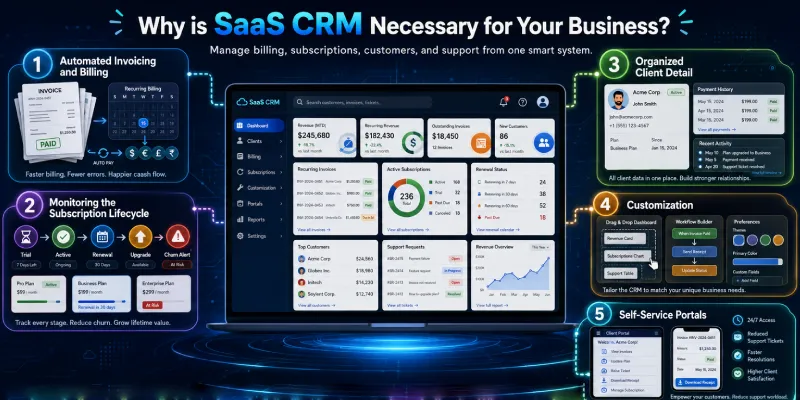
Creating recurring subscription invoices automatically to cut down on errors and manual labor.
Tracking every step of the client experience, from registration to renewal, and sending out milestone alerts.
Customer information, past interactions, and subscription status (active, cancelled, or expired) can be displayed in a single view.
Permitting plan updates, downgrades, add-ons, and subscription tier customization.
Enabling clients to examine invoices, modify payment information, and manage their own subscriptions.
Reducing manual follow-ups by implementing automated email procedures to notify clients of impending subscription renewals.
When a transaction fails, a methodical effort is made to collect the money, and automatic notifications are used to adjust payment methods.
Analyzing data to track important indicators that detect at-risk consumers and comprehend churn patterns.
Sales teams may monitor whether subscriptions are about to expire by using specialized pipelines to handle renewal possibilities.
Keeping an eye on users and their activities to spot users who aren't using the product and enabling proactive interaction to prevent cancellations.
The first step in the subscription lifecycle is acquisition, which aims to convert interested visitors into devoted customers. To increase the likelihood that prospects will subscribe and proceed, this stage needs to be seamless and reassuring.
Customers learn how to utilize the service and begin to see its benefits during the onboarding period. Companies assist customers by providing clear instructions and useful information. Subscribers feel empowered and are more likely to continue with this approach.
The ultimate objective of subscription lifetime management is engagement. It keeps your subscribers interested by encouraging discussion through newsletters, instructional materials, and feedback opportunities.
The renewal phase becomes apparent as a subscription period draws to a close. This is the time to remind clients of the benefits they have received and the reasons it makes sense to keep using the service.
In fact, the churn stage is an opportunity to learn why customers terminate their subscriptions and to offer insights. Even the churn stage can create long-lasting contact if handled carefully.
When a customer shows disinterest, that doesn't affect the reputation. Reactivation involves using the right strategy to capture interest and encourage former subscribers to return.
Explore More Related Articles
Event Management CRM for Better Attendee and Vendor Tracking
Trying to juggle cases, clients, and paperwork the traditional way...
Read MoreTravel CRM: Transforming Customer Management for Modern Travel Agencies
In today’s dynamic travel industry, agencies and tour operators must...
Read MoreDiscover ways to connect with your customers with our CRM software.