CRM Logo

Non-Profit CRM: Donor and Volunteer Management

In the non-profit sector, managing relationships is just as important as delivering impact. Organizations rely heavily on donors, volunteers, and community support to achieve their mission. Without a structured system in place, handling these relationships can quickly become overwhelming.

A well-designed non-profit CRM helps organizations streamline operations, improve communication, and build long-term relationships with supporters. From tracking donations to managing volunteer activities, it acts as a centralized platform that ensures nothing falls through the cracks.

A non-profit CRM (Customer Relationship Management system) is a software solution specifically designed to help non-profit organizations manage their interactions with donors, volunteers, and stakeholders.

Unlike traditional systems, they focus on relationship-building rather than sales. It enables organizations to store contact information, track engagement history, monitor contributions, and organize campaigns, all in one place.

Donors are the backbone of any non-profit organization. Managing donor relationships effectively can significantly impact fundraising success.

A non-profit CRM helps in:

  • Maintaining a detailed database of donors
  • Tracking donation history and patterns
  • Segmenting donors based on contribution levels
  • Sending personalized communication and updates

By using a non-profit CRM, organizations can build stronger connections with donors. Personalized engagement increases trust and encourages repeat contributions, which is crucial for long-term sustainability.

Volunteers play a vital role in executing non-profit initiatives. However, coordinating schedules, tasks, and communication can be challenging without proper tools.
A non-profit CRM simplifies volunteer management by:
  • Storing volunteer profiles and skills
  • Scheduling shifts and assigning tasks
  • Tracking participation and performance
  • Sending reminders and updates automatically

With this CRM, organizations can ensure that volunteers are engaged, informed, and motivated. Efficient volunteer management leads to better program execution and higher satisfaction among participants.

One of the biggest advantages of a non-profit CRM is centralized data management. Instead of maintaining spreadsheets or disconnected systems, all information is stored in a single platform.
This allows organizations to:
  • Access real-time data on donations and campaigns
  • Analyze trends and performance
  • Generate reports for stakeholders and audits
  • Make data-driven decisions

Having a clear overview of operations helps non-profits allocate resources effectively and improve overall efficiency.

Communication is key to building lasting relationships with donors and volunteers. A non-profit CRM enables organizations to maintain consistent and meaningful communication.

Features include:

  • Email and SMS campaign management
  • Automated follow-ups and thank-you messages
  • Event invitations and updates
  • Personalized messaging based on user behavior

With a non-profit CRM, communication becomes more organized and impactful, ensuring that supporters feel valued and connected to the mission.

Fundraising campaigns and events are essential for non-profit growth. Managing these activities manually can be time-consuming and prone to errors.

A non-profit CRM helps streamline campaign management by:

  • Planning and tracking fundraising campaigns
  • Monitoring campaign performance
  • Managing event registrations and attendance
  • Tracking funds raised in real time

This level of organization allows non-profits to run more successful campaigns and maximize their impact.

Automation is a powerful feature of any non-profit CRM. It reduces manual work and allows teams to focus on strategic activities.

Examples of automation include:

  • Sending donation receipts automatically
  • Scheduling follow-up emails
  • Notifying volunteers about upcoming tasks
  • Updating records in real time

By automating routine processes, this CRM improves productivity and minimizes errors.

As a non-profit grows, managing relationships and operations becomes more complex. A non-profit CRM is designed to scale with the organization.

It supports:

  • Increasing donor and volunteer databases
  • Expanding campaigns and outreach programs
  • Integrating with other tools and platforms

With a scalable non-profit CRM, organizations can continue to grow without losing control over their operations.

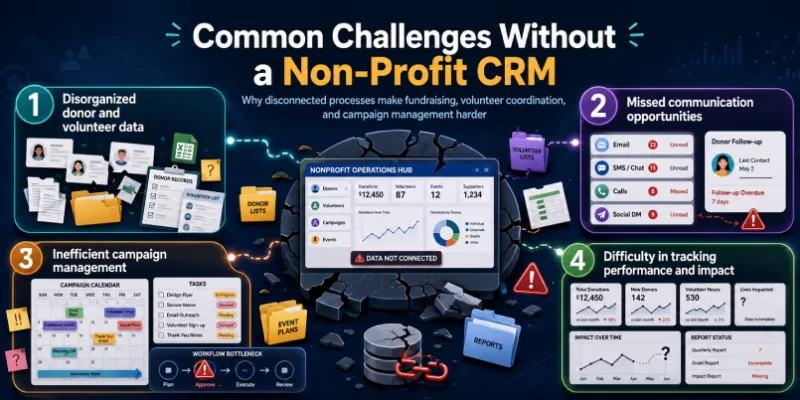
Organizations that do not use a CRM often face several challenges:
  • Disorganized donor and volunteer data
  • Missed communication opportunities
  • Inefficient campaign management
  • Difficulty in tracking performance and impact

Implementing a non-profit CRM eliminates these issues and provides a structured approach to managing relationships.

In today’s digital age, non-profits must adopt efficient tools to stay organized and impactful. A CRM is no longer a luxury but a necessity for managing donors and volunteers effectively.

By centralizing data, improving communication, and automating processes, a non-profit CRM empowers organizations to focus on what truly matters, their mission. Whether you are a small organization or a growing foundation, investing in the right system can significantly enhance your operations and long-term success.

A well-implemented non-profit CRM transforms how organizations manage their relationships, operations, and overall impact. By bringing donor and volunteer information into a single system, it eliminates inefficiencies and enables better coordination, communication, and decision-making.
From strengthening donor relationships to streamlining volunteer activities, a CRM empowers organizations to work smarter and more effectively. It not only saves time but also enhances transparency, accountability, and engagement, key factors for long-term success in the non-profit sector.
As the demands on non-profits continue to grow, adopting a reliable non-profit CRM is essential for sustaining and scaling impact. With the right system in place, organizations can focus more on their mission and less on administrative challenges, ultimately driving meaningful change in the communities they serve.

Explore More Related Articles

Discover ways to connect with your customers with our CRM software.