Trying to juggle cases, clients, and paperwork the traditional way...
Read MoreA customized version of conventional CRM systems created to address the requirements of construction companies. In addition to providing visibility into the pipeline and backlog of contractors, it serves as a consolidated platform for managing leads and optimizing bid decisions through an objective bid-ranking system. It integrates project management features while assisting you in managing connections with suppliers, clients, subcontractors, and other stakeholders.
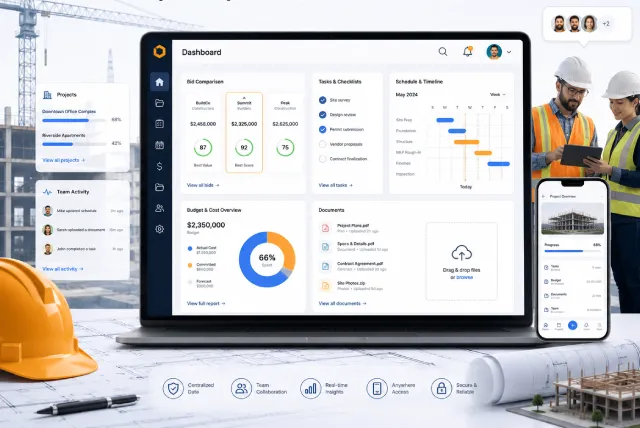
The bid management process is an advantage for construction companies, as it helps them effectively assess, develop, and present competitive proposals. Each step focuses on business improvement ensures that every opportunity is appropriately evaluated, qualified, and pursued. By ensuring each proposal is comprehensive, compliant, and aligned with project objectives and customer expectations, it reduces risk, saves time, and increases win rates.
Identifying the right projects that align with the company's capabilities and experience is the first stage of the bid management process. Construction teams monitor industry networks, customer databases, and tender portals to locate possibilities that align with their service offerings. Companies can focus their attention on reasonable bids that can be delivered within schedule, financial, and capacity constraints when opportunities are effectively identified.
Before committing, teams assess the project's scale, competition level, profitability, and resource availability. Managers can focus on possibilities that align with the company's strategy and have the best chance of success when a decision-making process is well-organized. This stage helps prioritize high-value projects and avoids wasting time on unfeasible proposals.
Your company’s bid planning and strategy development must be based on goals and submission deadlines. The bid manager collaborates with the design team and estimates to develop a clear plan of action. Strategic planning ensures the proposal offers a distinct competitive edge and that pricing, resources, and deliverables align with client needs.
All collected data is assembled into a comprehensive, precise bid document throughout the proposal preparation and submission stage. This includes schedules, qualifications, cost estimates, and compliance declarations. Before the client’s deadline, the bid manager checks the proposal for accuracy and consistency. Submissions that are organized and submitted on time show professionalism and improve the chances of getting the contract.
The bid management process proceeds to evaluation and negotiation following submission. Clients examine every proposal, contrasting prices, timetables, and technical solutions. To resolve client issues and bolster the company's position, the bid manager negotiates and provides clarifications. To ensure terms are reachable, effective negotiation focuses on balancing customer expectations with profitability.
After all the discussions and conversations, the client finalizes the contract to the winning bidder. With the best CRM software for construction, bid managers can minimize the burden of their tasks. This stage minimizes misunderstandings and maintains the project intent set during the proposal phase, ensuring a seamless transition from bidding to implementation.
When departments use various systems or approaches to monitor progress, it is very difficult to manage several bid opportunities separately. By centralizing project pipeline management, a construction CRM enables teams to monitor bids more effectively, prevent missed deadlines, and make sure no opportunity is missed.
The construction CRM offers a single platform to monitor all the organized (centralized) bid chances. Because of this centralization, you can be sure that nothing is missing. This helps business development teams, project managers, and sales executives to easily monitor several bids effectively. The construction industry demands effective CRM software to help businesses get more possibilities, leading to further expansion.
One of the highlighted factors of CRM software is real-time tracking of your construction site. Teams can effortlessly track bid progress, from submission to follow-up, using real-time bid status updates. These updates are available to business development and sales teams at all times, keeping teams informed. Additionally, this real-time insight ensures that any necessary modifications to deadlines or bids may be made quickly, enhancing the company's responsiveness to customer requests.
The approval of the contract is likely to be affected even if one deadline is missed. A construction CRM keeps teams organized and on time by centralizing bid data. The CRM tracks all important events, assignments, and due dates. Sending alerts and reminders to team members ensures on-time submissions. This lowers the possibility of missing important deadlines and improves the business's image for dependability and expertise.
Explore More Related Articles
Event Management CRM for Better Attendee and Vendor Tracking
Trying to juggle cases, clients, and paperwork the traditional way...
Read MoreTravel CRM: Transforming Customer Management for Modern Travel Agencies
In today’s dynamic travel industry, agencies and tour operators must...
Read MoreDiscover ways to connect with your customers with our CRM software.