CRM Logo

Best Manufacturing CRM: Managing B2B Relationships

Many manufacturing businesses lose valuable clients not because of poor product quality, but due to missed follow-ups, poor communication, and unorganized data. In a B2B environment where every relationship matters, even small inefficiencies can lead to major losses.

At this point, having a manufacturing CRM really makes things much easier to manage day to day. It helps businesses organize client interactions, streamline communication, and manage long-term relationships effectively. As competition increases and digital transformation accelerates, manufacturers that adopt CRM systems gain a clear advantage.

A well-implemented CRM system allows teams to stay aligned, reduce manual work, and focus on building meaningful client relationships that drive long-term growth.
A manufacturing CRM is designed specifically to meet the needs of manufacturing businesses, where sales cycles are longer and involve multiple decision-makers. It provides a centralized platform to manage all customer interactions efficiently.

This structured approach ensures that no opportunity is missed and all teams work with accurate, real-time information.

In manufacturing, relationships are long-term and highly valuable. Because clients place repeat orders over long periods, keeping regular engagement with them plays a big role in business success.
Choosing the right CRM system is essential for maximizing efficiency and performance. A well-designed manufacturing CRM should include features that support both sales and operational processes.

These features help businesses stay organized and improve overall workflow efficiency.

For B2B manufacturing, the best CRM systems are those that bridge the gap between sales and production. They integrate with ERP and PLM systems while supporting long and complex sales cycles.
A few commonly used CRM platform includes:

Salesforce Manufacturing Cloud

Best suited for large enterprises handling complex, multi-stage sales processes. It offers advanced forecasting, automation, and account-based management features.

Microsoft Dynamics 365

Ideal for organizations already using Microsoft tools. It connects your sales, finance, and supply chain processes, giving you live insights to manage operations better.

CRM Hub 360

A flexible and scalable solution tailored for growing manufacturing businesses. It simplifies workflows, improves client relationship management, and enhances team collaboration without heavy technical complexity.

HubSpot CRM

A strong choice for mid-sized companies focused on marketing and lead generation. It helps attract, nurture, and convert leads effectively.

Oracle NetSuite CRM

A powerful ERP and CRM combined platform, best for large-scale manufacturers needing full visibility into financials, inventory, and customer data.

Zoho CRM

An affordable and customizable option for small to mid-sized businesses, allowing tailored workflows and automation.

LeadSquared

Designed for field sales teams, offering features like GPS tracking, offline access, and dealer management for on-ground operations.

Implementing a CRM system helps businesses operate more efficiently and improve overall performance. It reduces manual work and allows teams to focus on strategic activities.
A manufacturing CRM provides measurable benefits that directly impact growth.
Key benefits include:
These benefits contribute to stronger relationships and long-term business success.
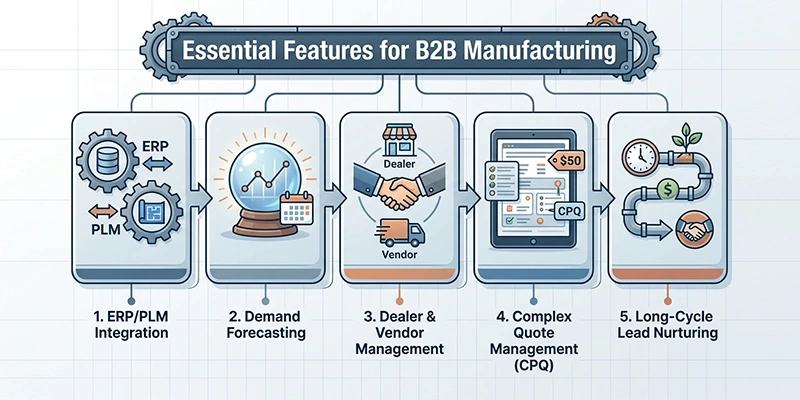
To effectively manage both sales and production processes, CRM systems must include advanced capabilities tailored for manufacturing.

Key features include:

ERP/PLM Integration

brings alignment between sales orders, production planning, and available inventory

Demand Forecasting

Helps plan resources using historical and pipeline data

Dealer & Vendor Management

Centralizes partner information for better coordination

Complex Quote Management (CPQ)

Enables accurate pricing for technically complex products

Long-Cycle Lead Nurturing

Supports extended sales cycles with automated engagement

These capabilities make a manufacturing CRM highly effective in real-world scenarios.

Without a structured system, managing customer relationships becomes inefficient and error prone. Many manufacturing businesses still rely on manual methods, limiting their growth potential.
Common challenges include:
A manufacturing CRM eliminates these issues by providing a centralized and reliable platform.
Selecting the right CRM requires evaluating business needs, scalability, and ease of use. The system should integrate smoothly with existing tools and support long-term growth.
A good CRM should offer:

Cloud-based solutions also enable better collaboration across teams and locations.

In today’s competitive landscape, building strong B2B relationships is essential for success in manufacturing. Businesses must adopt efficient systems to manage communication, track opportunities, and ensure consistency. A reliable manufacturing CRM enables companies to streamline their processes and maintain strong connections with their clients. With solutions like CRM Hub 360, businesses can take relationship management to the next level by improving visibility, coordination, and customer engagement. If you are looking to simplify your operations and strengthen your client relationships, now is the right time to invest in the right CRM solution.

Explore More Related Articles

Discover ways to connect with your customers with our CRM software.